
Shadow Work on the Black Moon Lilith Rising Podcast

Recently, I was able to join my friend Adama on her podcast, The Black Moon Lilith Rising Podcast. In our episode we were able to talk about shadow work and how Jung unifies the worlds of psychology, spirituality and astrology. I had a lot of fun in this episode and hope that you enjoy listening!Listen to the episode at the link below:
https://www.lilithastrology.com/podcasts/black-moon-lilith-rising/episodes/2147824170
You can also learn more about Lilith Astrology and Adama's work at LilithAstrology.com and on Instagram @lilithastrology.
What Shadow Work Means & What to Expect
Writing a book is hard work. Marketing a book that you wrote is a whole different beast! I was glad to work with the Simon & Schuster team to create this quick video that talks a bit more about shadow work and how it can help you embrace your inner self.
Check out the clip below!
Shadow Work: Demystifying the Helpful, but Arduous 3 Stage Process
*This post contains an affiliate link.
In an earlier post, I wrote about what every beginner should know about shadow work. Today, I want to take it a step further and detail what I think are three main stages of shadow work.
The goal of shadow work is to make the unconscious conscious. You are able to make that connection through consistent effort in reflecting more deeply through practices such as shadow work journal prompts, trauma-informed grounding, and affirmations for self-compassion. The last bit is particularly important as shadow work typically involves contact with less desirable parts of yourself - and, of course, that doesn't always bring out the most hopeful thoughts and feelings for us.
Ultimately, shadow work has a lot of personal value and the goal is to heal parts of yourself that you didn't realize needed healing. Shadow work also helps you work to accept all parts of you because they are, well, part of what makes you YOU.
I think of shadow work as occurring in three main parts: detachment, exploration or growth, and integration.

3 stages of shadow work graphic jorel caraballo
Detachment
Detachment is a stage, or a state, of being disconnected from one's self and experiences. With respect to shadow work, this doesn't just involve being disconnected from feelings in any particular moment in your day, but more so being detached generally from your deep-seated feelings and worries. In my experience, this means also being detached (or often minimizing) the hurt you've experienced throughout different parts of your life.
If you ignore your pain you also miss an opportunity for relief and healing. You can’t heal what doesn’t hurt.
Detachment usually offers you the ability to not feel all the things you don't want to feel. It also affords you the ability of not disrupting the ways in which you like to see yourself, as is often necessary in shadow work.
This is the stage before any actual shadow work begins. It is usually the space we occupy most often and it often feels like discomfort and confusion about your own motivations and reactions. You may realize something isn't quite right but you're not sure what it is or how to go about addressing your concerns.
Exploration
This stage of shadow work is the first active stage of "work." Simply put, this is the work of reflecting more deeply, delving into your memories and making space for unconscious material to come up.
A shadow work workbook will help you by typically offering meditations and journal prompts to dig more deeply. Like most personal development work, it can ebb and flow depending on your capacity and other things going on in your life, and how you prioritize this kind of work.
In this stage you're like to experience a range of emotions like joy and relief, as well as sadness and grief. This stage is all about revealing deeper truths and making important psychological (and/or spiritual) connections. You are likely to learn a great deal about yourself and start to see a clear path towards self-acceptance and healing. That being said, this phase is often very tough to work through, as you might imagine.
Integration
This final stage is all about working to integrate the emotional material revealed in the exploration stage. This means finding a way to apply what you've learned in your reflections into everyday life.
For example, if you were able to learn about your pattern of feeling helpless, integration would look like implementing new ways to use your personal power or agency in situations in your life. That might sound like learning to set boundaries with loved ones or work, for example. Integration could also look like forgiving yourself for past mistakes and learning to live alongside your guilt without letting it completely derail your sense of self. You may adopt a practice of self-compassion to help you work on that. Any of these things can be worked on solo or with the help of a licensed therapist.
When you're in this stage, it can also feel surprisingly tough to adjust to the changes you're making in your life. You will have to deal with how your changes also impact those around you. The really great news is that you will feel a greater sense of ease and inner peace as you accept your imperfection.
I hope this provides some important clarity on what shadow work is and what to expect in the process.
You can learn more by connecting with me on Instagram @jorelcaraballo.
FAQ: What is shadow work?
Shadow work is the process of making the unconscious conscious. It was coined by Carl Jung to help promote internal self-awareness and acceptance.
Why I'm Writing a Book About Shadow Work
*This post contains an affiliate link, for which I may earn a small commission for any purchases. You will incur no additional costs at time of purchase.
I'll admit that even in the field of psychology shadow work isn't exactly a mainstream idea, so then why write about it? I think the key to better mental health, both within an individual and in the larger collective society, is about making the unconscious conscious.
What is shadow work?
In essence, making the unconscious conscious is at the root of shadow work. The shadow, as conceived by Carl Jung, represents the often hidden (and almost always undesired) parts of ourselves that we regularly have a hard time accessing. As we go about our daily lives, tending to our regular tasks, we all carry with us a shadow self.
Within in this shadow self are our deepest motivations, our hidden gifts, and our most profound traumas. If we work to cast a light on this shadow self, we can work towards true acknowledgement...and hopefully acceptance. Shadow work gives us a pathway towards this integration, ensuring that we learn to live alongside our shadow selves with a greater sense of awareness. With that awareness comes greater sense of personal ease and peace, as well as diminished likelihood that shadow self will run amok, working behind the scenes as it complicates our relationships, career and mental health.
Is the world changing...or are we, the people, changing?
In the past few years, we've seen a huge cultural shift in how greater society and politics shape our lives. This is true for the United States, but you may have noticed that white supremacy and white nationalism are up all around the world.
More broadly, there is an increase in violent rhetoric online and it's hard to escape the depth of pain that we're all experiencing on a day to day basis. It's clear to me that struggles for power, deep-seated feelings of envy and hatred, as well as self-loathing are more present than they have been in the past couple of decades.
As a therapist, and a healer, I believe this marks a cultural shift. There is an incredible amount of pain and grief in the world that we live in. I spend most of my days helping clients sift through that pain and make their way to fuller lives whether we're exploring career changes or relationship concerns. The context in which we live is challenging for many of us.
On top of that, the pandemic seems to have presented a reckoning for so many people. Some people began to realize just how unsatisfied they are with their lives. Others find it hard to be swayed by divisive beliefs on the corners of the internet.
As a young child, I was a fan of Greek mythology and it's almost as if Pandora opened the box herself in the past few years. Now, we're faced with an insurmountable amount of grief and loss collectively, all while navigating the challenges in our own personal corners of the world.
Eyes wide open
There is no doubt in my mind that the past few years have opened us all up in ways that we didn't anticipate. As all those darker sides of humanity (bigotry, violence, selfishness, etc.) find more ways to rear their ugly heads, I can't help but wonder how much better, or healthier, we could all be if we spent more time understanding ourselves in much deeper ways.
How might we be able to feel better, feel more connected, and more secure if we found ways to really BE with ourselves and accept ourselves...even the darker parts, more fully? How could the world look different if we all did our part to understand our rich, internal lives, so we didn't leak on others, or feel the impulse to project onto others our deepest insecurities and fears?
This is why I think shadow work is so important right now.
Healing comes through integration
While I don't claim to have all the answers (in fact, I think any wise person knows that they, in fact, know very little) I know through simple observation that as a collective, things really need to change in order for our world to sustain itself. Before we can really learn to take care of society's most vulnerable, before we can build families with a legacy of fulfillment and kindness we all have to do our part - our own internal work - to be the best versions of ourselves that we can be in this moment.
If you know that you are doing that - that you are embodying this best version of yourself right now, then I wholeheartedly commend you. As the world continues to spin, let us all make a concerted effort to create a world where we feel at peace internally - and have no problems in extending that peace outward. I think we desperately need it.
Shadow Work: What Every Beginner Needs To Know For Better Mental Health
If you've spent some time in the psychology or self-help sections of a bookstore then maybe you've come across this idea of shadow work. I'm here to provide some clarity on what shadow work is and how it can benefit your mental health.
Carl Jung helped make shadow work mainstream
Analyst Carl Jung is the theorist behind the idea of the shadow and shadow work. In essence, whereas Sigmund Freud came up with the idea of making the "unconscious conscious" Jung reimagined the shadow as an unconscious part of the self that needs acceptance and integration to be "resolved". He felt we could live with the unconscious shadow self through a process of examination and integration leading to better mental health. These are very similar concepts, with slightly different language and perspective. Often cited in spiritual circles, Jung's work often highlights a more holistic perspective on mental health than his contemporaries, which is why a lot of the shadow work material you'll find is provided by healers of different disciplines.
I think this quote on consciousness summarizes Jung's perspective very well...
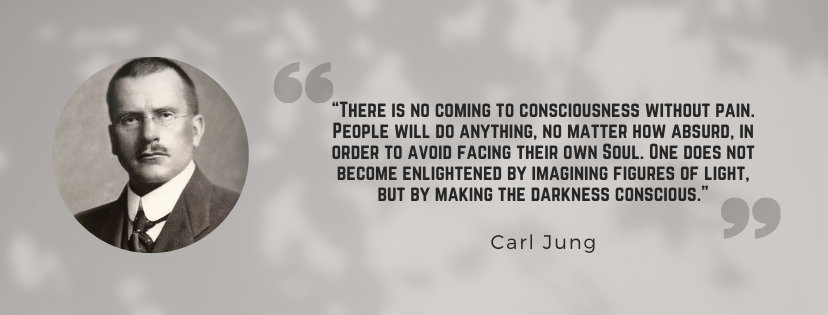
Carl Jung image source: Vision.org
Making the unconscious conscious
Jung believed that if we were to make the unconscious conscious (and become aware of ourselves in ways we don't normally devote time to) then we could 1) feel more whole, enlightened, and integrated and 2) be empowered to take daily actions that help bring more fulfillment and peace in our lives. And, who wouldn't want that? But, what could that look like exactly?
For example, let's say that as a young child you were very interested in art and painting. As you grew up, you received less and less affirmation for your interest, or skill, and art fell by the wayside. Now, you're in your mid 30s and struggling to find fulfillment in life. You don't like your job but it otherwise provides structure and financial security that you need. You feel uneasy with it but aren't sure why because you don't see a "problem."
Enter shadow work.
Here shadow work would help you explore, and make connection to your inner child, and find a way to connect with art and creativity again. That may not necessarily lead to becoming a full time artist, but it could mean making sure to incorporate a more creative process in your life regularly so that you feel more at peace and in connection with, a deeper part of yourself.
This is one example of what shadow work could help you with. I will continue to share more about shadow work here AND you can also order my book The Shadow Work Workbook scheduled for release September 2022.